

-
Using CPVC adhesive
-
- 01Applying adhesive
-
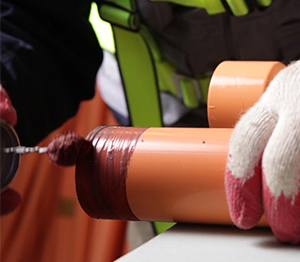
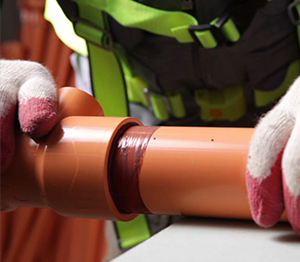
When applying the adhesive, apply the adhesive from the fitting to the pipe and use sufficient amount of adhesive while rotating so that it is applied evenly on the joining surface but ensure that the application amount is not excessive, causing overflow.
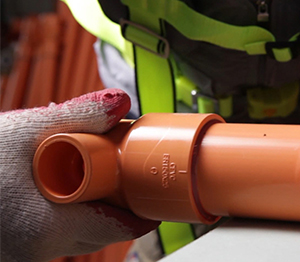
As for appling adhesive, apply until you hear the "smacking" sound of CPVC material melting but in case adhesive has been applied on areas other than the joining part, wipe off and push in until the end while turning the pipe ½ way (so that adhesive disperses evenly), join and wait for approximately 3 seconds.
- 02Compliance with curing time
-
Full curing time of WELD-ON soluble adhsive
①On the condition that relative humidity is below 50% / ② Full curing time refers to time required for maximum pressure that can be used*Indicate the insertion length by using a black pen (oil-based) on the outer part of the pipe after pipe cutting and burr removal work.Standard Min. insertion length Remarks 25mm 28mm As for the insertion depth upon joining,
the depth of each fitting differs slightly and the minimum insertion depth
on the left is the average32mm 31mm 40mm 34mm 50mm 38mm 65mm 44mm 80mm 47mm 100mm 57mm -

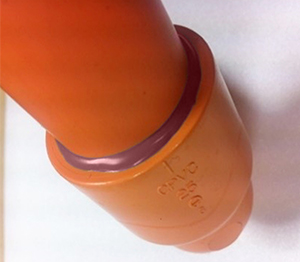
Apply adhesive bead so that it can be seen visually
After making the indication on the outer part of the pipe according to the abovementioned insertion length, the indication line can't be seen in the bead upon complete joining (ring type of adhesive that is pushed out upon joining). -
In other words, full curing time is the minimum period that must be maintained prior to appling water pressure after piping is complete and it is based on more than 24 hours during summmer/more than 7 days during winter.
In case pressure is applied without complying with the abovementioned curing time, it may cause the pipes to deviate.
-
How to handle CPVC adhesive
-
-
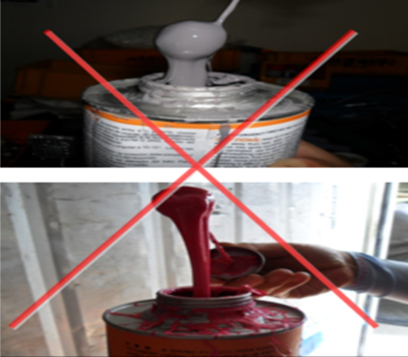
Coagulated bond cannot be used
Apply adhesive to the product in a clean and dehydrated state.
Avoid excessive use of adhesive (resistance of flow)
Do not use hardened or jelly adhesives.
Beware of sparks and flames
The container cover must be closed after use.
Avoid contact with eyes/skin
Observe the minimum elapsed time after bonding of pipes and fittings.
Store at room temperature and do not use when freezing.
Adhesive is highly volatile so it may dissipate when not sealed completely so the lid must be closed completely during storage.
(Use within 1 year/Expiry date: 2 years from the date of manufacture)※If the working temperature is below -10℃, the bonding quality and working efficiency of the adhesive may be deteriorated.
-
-
Hydraulic test
-
- 01As for the hydraulic test of CPVC pipe, wet hydraulic test is carried out in principle.
- 02As for the sprinkler system, it is recommended that water pressure is carried out after discharging water to remove air within pipe and residual solvent gas before pressurization.
- 03Water pressure, based on 1.2MPa (maximum working pressure of performance test standard of pipe of synthetic resin for firefighting), should not exceed 2.0MPa and it is recommended that it is maintained for at least more than 24 hours.
-
(However, check the internal pressure relationship such as new pipe and sprinkler head to pressurize.)
- 04When conducting hydraulic test, comply with and implement full curing time of joint pipe by considering the ambient temperature conditions.
- 05Using anti-free during winter may shorten the lifespan of the product so prohibit its use and when conducting the air pressure test, check that it doesn't exceed 5kgf/㎠ maximum and when conducting the air pressure test,
open the valve at the end and maintain the pressure by slowly closing in ventilated status. -
(As for the air pressure, part of the pressure may drop regardless of leakage and in case the pressure drops to "0" within 24 hours, leakage should be suspected.)
-
General precautions
-

- Pre-welding, post-piping work
-
In case welding with other material is required during CPVC piping work, welding work must be completed before joining the CPVC pipe.
(In case volatile gas that has been produced during joining work builds up, there is a possibility of explosion caused by welding fire)

- Avoid direct sunlight
-
In case CPVC pipe and joint pipe are stored outdoor, avoid direct sunlight and countermeasures, such as covering with cloth must be taken to block heat.
- Avoid impact and scratch
-
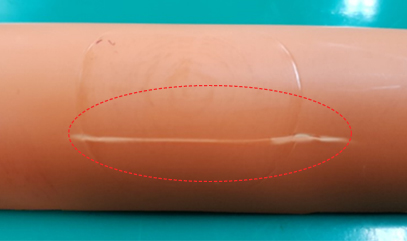
Handle with care to prevent impact or scratches or scar caused by sharp object on surface of pipe and joint pipe.
In particular, be aware of impact in temperature below zero during winter.
(Products with bleaching phenomenon upon impact indicate that quality has dropped so it must be replaced)
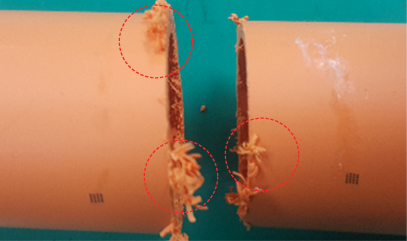
- Burr produced Diamond blade or grind stone blade is recommended
-
When cutting the pipe, use electric high-speed cutter but chamfer work must be done to remove burr.
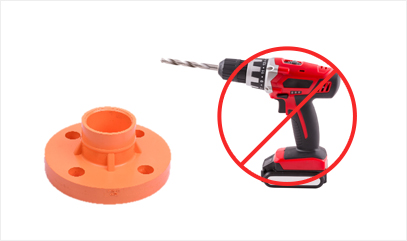
- Use of electric drill prohibited during flange installation.
-
Crack may be caused during flange instalaltion so using electric drill is prohibited.
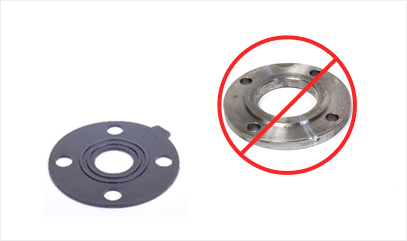
- Use TKG Aikang's dedicated bracket
-
TKG Aikang's dedicated gasket (rubber material-EPDM) must be used.
Using other materials may cause leakage.
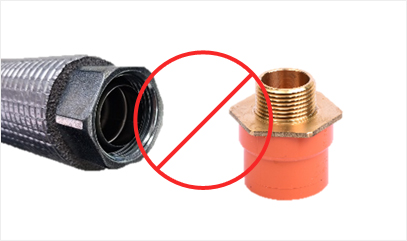
- Using CPVC valve socket (PT) and valve socket (SP) together is prohibited
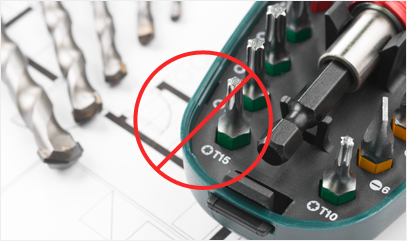
- Arbitrarily processing seamed pipe screw is prohibited
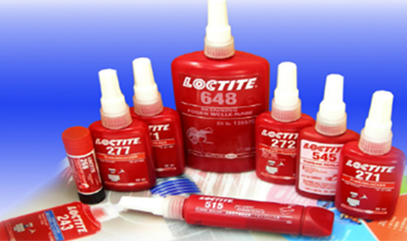
- Using anaerobic adhesive (screw fixing agent) is prohibited
-
When using screw fixing agent in the joint pipe made of other material, in case it is close to plastic material,
liquid product may overflow or become vaporized, affecting the plastic material and may cause stress cracking.
(When fixing screw at the joint pipe made of other materials, Teflon, cotton combed, sealing compound are recommended)
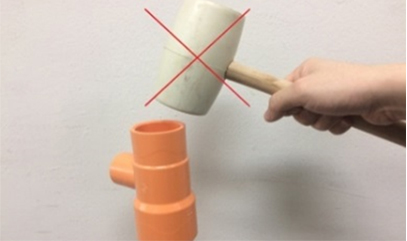
- Impact prohibited when connecting joint pipe
-
When joining CPVC joint pipe, do not engage in act such as hitting the product with a rubber hammer to insert for convenient insertion.
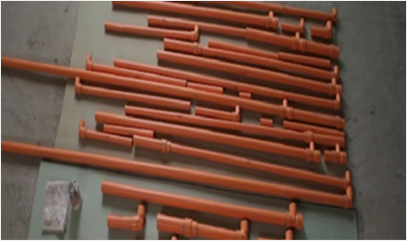
- Solvent gas discharge
-
Comply with the curing time and sealing immediately after joining the pipe isp prohibited (Must remove solvent gas within the CPVC pipe)
If the solvent contained within the adhesive is not discharged in the pipe and in case of convection, it could cause solvent crack.
Precautions when connecting with other pipe materials
-
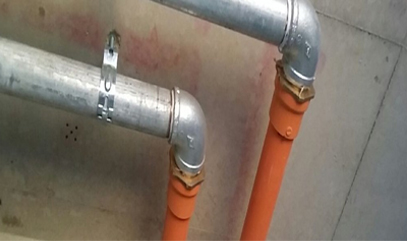
Insert M valve socket flage connection (Gasket type)
-

Flange connection (Gasket type)
-
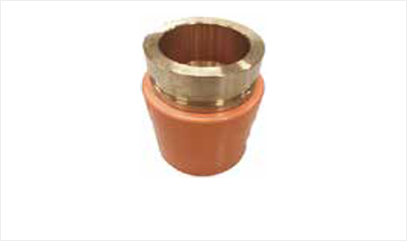
Groove type connection
1.Connection with other pipe material can be carried out with flange or metal type of valve socket.
2.When connecting the Insert M valve socket, always check if the fastening with CPVC valve socket is appropriate and connect by using Teflon tape or cotton yarn. When connecting Insert socket vale, never use chemical adhesives (anaerobic adhsive). (Contact manufacturer)
3.Generally, under 50mm, connection with M valve socket (brass) is recommended while flange is recommended for more than 65mm
4.When connecting the flange, the gasket provided by the manufacturer must be used. (Dedicated gasket for CPVC)
Precautions when connecting SP flexible joint
-
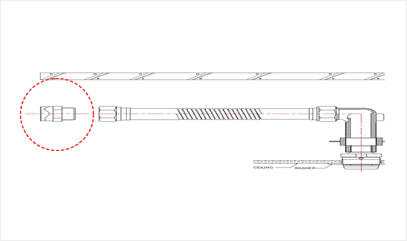
25mm insert valve socket (for SP)
-
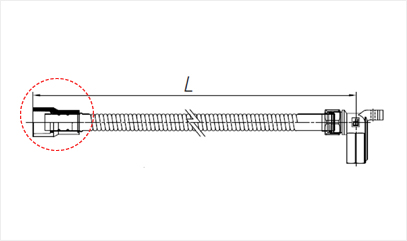
25mm integrated new pipe
-

25mm height adjustable elbow
1.When connecting the SP joint within household, connect in screw method when joining with C-PVC.
2.As for CPVC 25mm insert valve socket (for SP), remove the SP flexible nipple and connect directly with the valve socket (for SP)
3.When joining with SP joint, using Teflon and chemical adhesive is prohibited When using Teflon, it may not be placed close to the o-ring of SP joint or o-ring can become damaged due to chemical reaction with chemical adhesive
4.Over-tightening prohibited - Over-tightening with air tight maintaining method caused by o-ring may damage the o-ring